
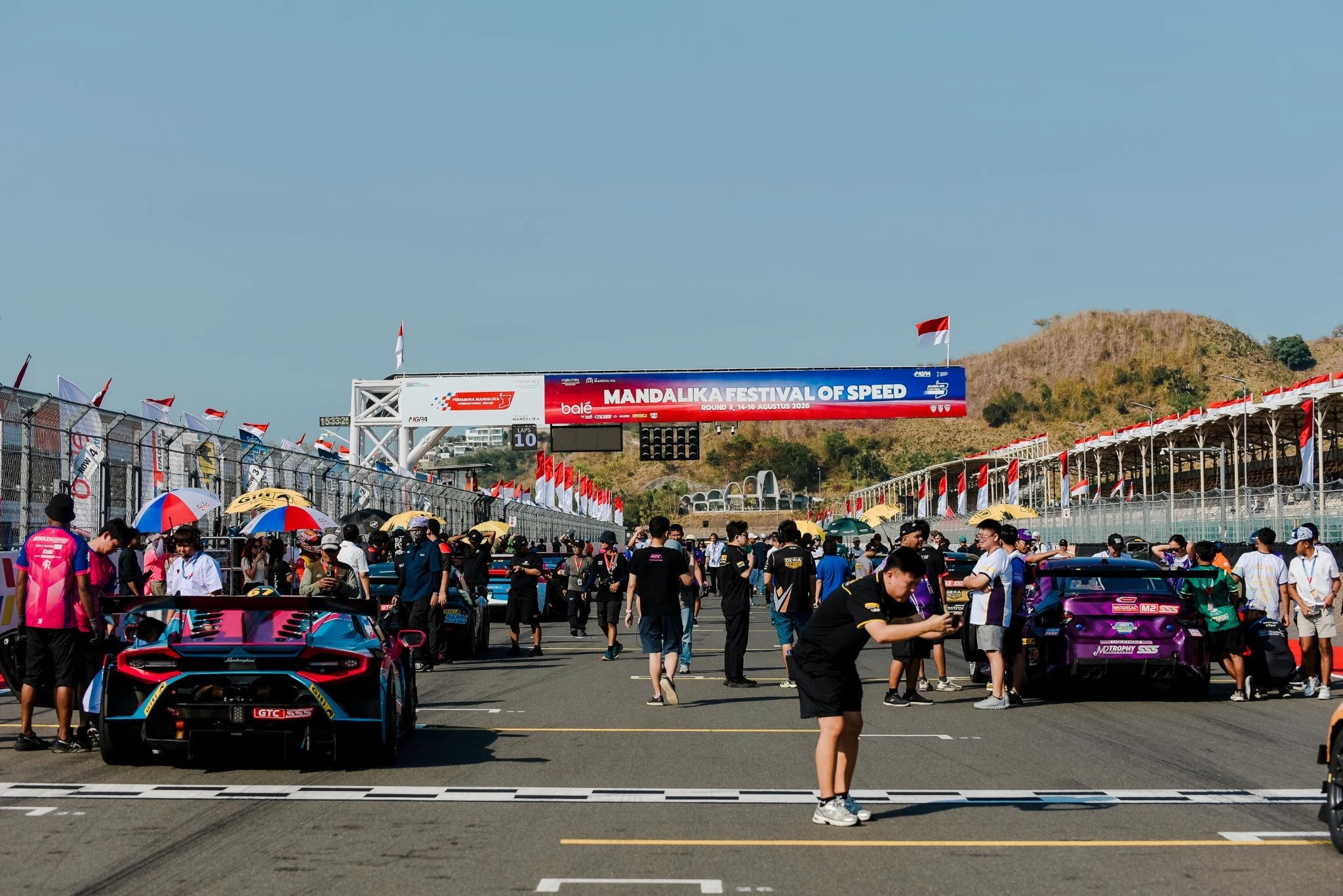
Minutes before the Superstars Sportscar Series race gets underway | Credit: Superstars Motorsport
Sharing the bill was the Superstars Sportscar Series (SSS). Launched just this past May, this brand-new, independently run championship brought BMW M2 GT4, GTC, and GT3 cars from manufacturers like Porsche, Lamborghini, and Mercedes-AMG.
The result is a dense domestic motorsport environment where drivers, teams, engineers, and mechanics can operate across different levels of competition, even when the championships themselves remain independently organised.
For MFoS, that shared environment is part of the event's wider ambition to build a sustainable motorsport culture around Mandalika. For Superstars Motorsport, however, SSS has a separate ambition: to provide a high-level domestic sports-car platform that connects Indonesian talent with international competition.
At MFoS Round 3 in August, Mandalika showed both sides of that ambition.
Mandalika is trying to become something
Launched in May 2025 alongside the track’s inaugural GT World Challenge Asia round, MFoS serves as a central hub for domestic motorsport. To draw crowds between major races, the event packages on-track action with entertainment, food stalls, and local MSME showcases.
According to former Mandalika Grand Prix Association (MGPA) President Director Priandhi Satria, the goal is to combine competitive racing with a festival format that actively engages the surrounding community.
MFoS brings several layers of domestic racing into the same weekend. The Krida Agya OMR gives entry-level racers a low-barrier way into circuit competition. At the same time, the BRZ Super Series and ITCR provide more demanding machinery and racecraft. Meanwhile, SSS brings a separate, independently run GT championship to the same Mandalika weekend.
While a shared paddock creates natural opportunities for drivers, teams, and engineers to interact, it doesn’t automatically fuse separate championships into a single organisational ladder. The more compelling question is whether housing these distinct sectors of Indonesian motorsport under one roof can spark long-term benefits that outlast a single race weekend.
What happens when different levels share a paddock
The weekend offers different levels of racing for different experience levels and budgets. It starts with an easy “arrive-and-race” system for beginners, where drivers can just show up and drive. From there, the competition gets harder as you move up to the faster touring cars and the high-end GT machinery.

The race start of Krida Agya OMR | Credit: Mandalika Grand Prix Association
The intimate MFoS paddock offers an underrated catalyst for industry networking. From a driver's perspective, however, the organisational distinction does not necessarily change the practical value of sharing the same paddock.
What benefits does a shared paddock offer for the participating series at MFoS, and what does this collaborative environment mean for the future of Indonesian motorsport?
"With everyone sharing a single paddock, drivers can easily connect, talk, and secure the resources they need”, says Rocket Racing Bali driver Nadeem Rustombi. “It creates a great environment for Indonesian motorsport to keep improving."

The Subaru BRZ Super Series in action | Credit: Mandalika Grand Prix Association
For Superstars Motorsport, SSS represents a continuation of the higher-level GT racing infrastructure the company says it has been developing in Indonesia since the Porsche Sprint Challenge Indonesia (PSCI) era.
The company sees its role as creating a domestic platform that can support drivers and teams aiming for higher levels of competition, rather than simply providing another destination within MFoS.
They also highlighted David Djaja as a more established example of progression between domestic categories. Djaja won the 2022 ITCR 1500 national championship before joining PSCI in 2024 with a Cayman GT4 RS. A year later, he moved into the Porsche 911 Cup car and won the 2025 overall title.
The example supports the idea that domestic racing can feed into higher levels of competition. But it is also important to distinguish that pathway from MFoS itself, as Djaja's progression runs through championships with their own structures, rather than a single MFoS ladder.
The organisers expect this international connection to bring new knowledge and technology to local engineers and mechanics. While this remains a long-term goal rather than something one weekend could achieve on its own, the groundwork is being laid.
The paddock as the point
Sharing the same workspace naturally transforms the diverse paddock into a tight-knit community. Capitalising on this collaborative atmosphere, the organisers actively extend that accessibility to the grandstands by delivering an approachable festival environment for the audience.
The event strips away traditional financial barriers by dropping spectator ticket fees and broadcasting the full weekend live on YouTube. Trackside, the weekend focuses on a free pit walk that opens the paddock to the public. This gesture aims to organically seed motorsport culture into the surrounding region.
At Mandalika, the people were often easier to follow than the championship structure. Veteran journalist and racing driver Fitra Eri Purwotomo drew massive engagement both on-site and online. The spotlight extends through his son, Farrel Rafellyno Augusto, who competes in the ITCR 1200 as a factory driver for TGR Indonesia.

Honda Racing Indonesia team members in the garage | Credit: Mandalika Grand Prix Association
According to MGPA President Director Ananda Mikola, the true value of the event lies in its ability to bring Indonesia's most experienced drivers directly with rising talents. This open environment lets younger drivers observe professional dynamics firsthand and accelerate their growth in a competitive ecosystem before considering international competition.
Superstars Motorsport CEO Bagoes Hermanto is confident that the newly introduced SSS will set a new benchmark, creating a positive trickle-down effect across the entire motorsport ecosystem. Superstars Motorsport argue that internationalisation is already beginning on the SSS grid with the arrival of Mercedes-AMG, Lamborghini, and Porsche GT3 machinery, as well as Giti Tires becoming the single competition-tyre supplier for SSS.
The harder part: making people care
Securing the physical infrastructure is only the first step in building a self-sustaining motorsport platform. The true test lies in the ability to generate long-term value that keeps the stakeholders committed to the venue. Pure track action lacks the momentum to stand alone without continuous community and institutional support.
Racing quality is judged by its depth, competition, and risk. Small grids create a sporting problem: when only one or two cars are competing for a class, finishing position tells the reader less about competitive depth.
Because SSS is new, it is still sorting out early logistics. The grid was tight at just 10 cars, mostly because adding the faster GT3 class meant losing the basic TCR-class cars that raced in earlier rounds

The starting grid of SSS Round 6 | Credit: Mandalika Grand Prix Association
Meanwhile, competitions elsewhere are tight since everyone shares the same machinery in a dense field. This takes car performance out of the equation, leaving nothing but pure driving skills and bravery to determine who will be standing on the podium by the end of the race.
The problem becomes more obvious once the racing leaves the circuit and reaches the screen. MFoS' YouTube broadcast is carrying a growing collection of championships, but the production often treats the programme as one continuous stream rather than a collection of distinct racing products.
During the August weekend, corporate announcements and off-track interviews sometimes competed with qualifying or active racing for the same airtime, making it harder to follow the sporting narrative.
For an established local audience, that may be navigable. But to someone encountering MFoS for the first time, it makes the hierarchy of the weekend difficult to understand. The product therefore has to communicate as well as it races.
Building a media system requires separate, specialised roles. Ricky Sitompul is currently juggling many roles as the announcer, analyst, reporter, and track MC all at the same time. To move past a basic track-day look, the production needs more voices.
Splitting these heavy duties across a full team is among the ways to build motorsport media careers in Indonesia. This regional approach mirrors steps taken by F4 Saudi Arabia, which has begun opening up both engineering and media roles as internships for local students.
If Indonesian motorsport wants to attract international drivers, manufacturers, and sponsors, its audience-facing product must match that same global standard.
MGPA builds its crowd numbers by keeping admission free and offering pit lane walks with merchandise giveaways. Even with free tickets and a holiday boost from the Indonesian Independence Day weekend, grandstand seating remained visibly sparse during the August round.
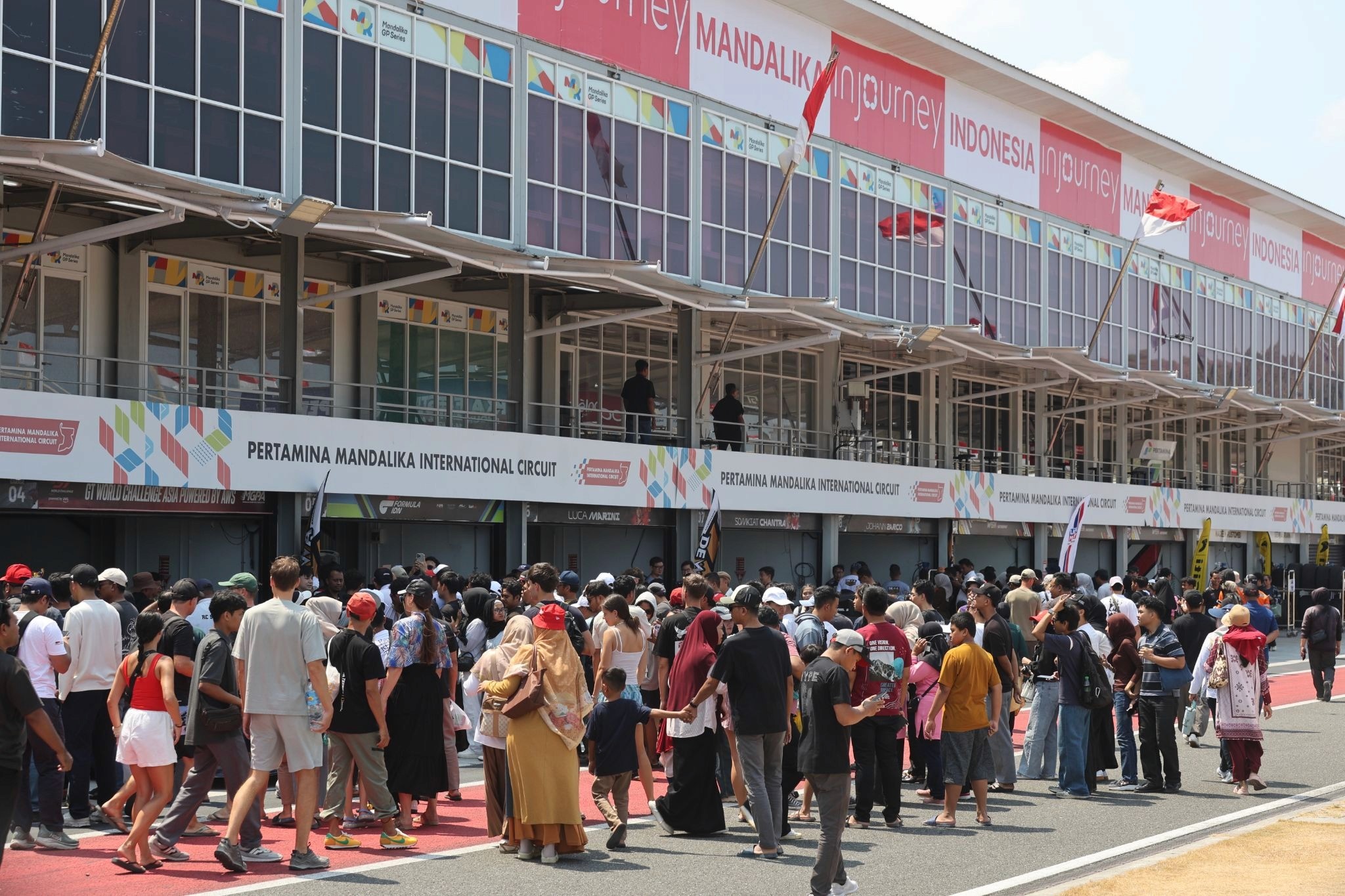
The pit walk shortly following the opening ceremony | Credit: Mandalika Grand Prix Association
This turnout raises a clear question for the circuit's future sustainability. Management must eventually evaluate how long it can afford to run a free event, how much of the audience is returning specifically for the racing, and which measures it uses to determine whether MFoS is building a sustainable following.
The weekend also raised questions about operational discipline. Teams were observed smoking inside the active paddock, close to race fuel and competition machinery.
The lack of organisation extends to the media centre, where the screens in the media centre were not providing live timing or race feeds. This forces journalists needing to head downstairs to seek out individual team garages just to catch a glimpse of telemetry.
For a venue aiming to become a regional motorsport hub, these operational nuances are foundational. International credibility is forged through the entire event experience, stretching far beyond the technical specifications of the cars on the track.
What comes next?
Mandalika has built something that did not exist here a few years ago: a domestic weekend where entry-level one-make racing, touring cars and high-level GT machinery can share the same paddock, while drivers, teams and technical partners move between them.
The harder question is what happens next. An international pathway cannot be measured only by the cars on the grid, but also by the standards expected in the paddock, the quality of the competition, the way the racing is presented, the people who keep coming back, and the international teams and partners that decide the event is worth joining.
MFoS has started building that ecosystem. The August weekend showed that the ambition is real. It also showed how much work remains before the experience surrounding the racing matches the level of the cars themselves.


