The last time a woman raced in Formula 1 was 1976. Lella Lombardi is still one of only two women ever to start a Grand Prix, and the only one to score a point, at a Spanish Grand Prix cut short by a fatal crash. Half a century on, that point remains the whole of it, and the grid has been silent since.
That silence is starting to look conspicuous. Women’s elite sport is on course to pass $2.3 billion in global revenue this year; the 2025 Women’s Euros was the most-watched sporting event of its season in both Germany and the UK. Almost every corner of sport is being rebuilt around female talent. Except, it seems, the one that goes fastest. Why motorsport has stayed stuck is the question More Than Equal was built to answer.
Co-founded by David Coulthard and Czech entrepreneur Karel Komárek, the organisation has one stated goal: finding Formula 1's first female world champion, and unusually, the machinery to chase it. Below the driver-development programme the public sees sits an iceberg it doesn’t: a dedicated research arm, the largest database of female motorsport performance in the world, and a talent-identification model borrowed less from the paddock than from Olympic sport.
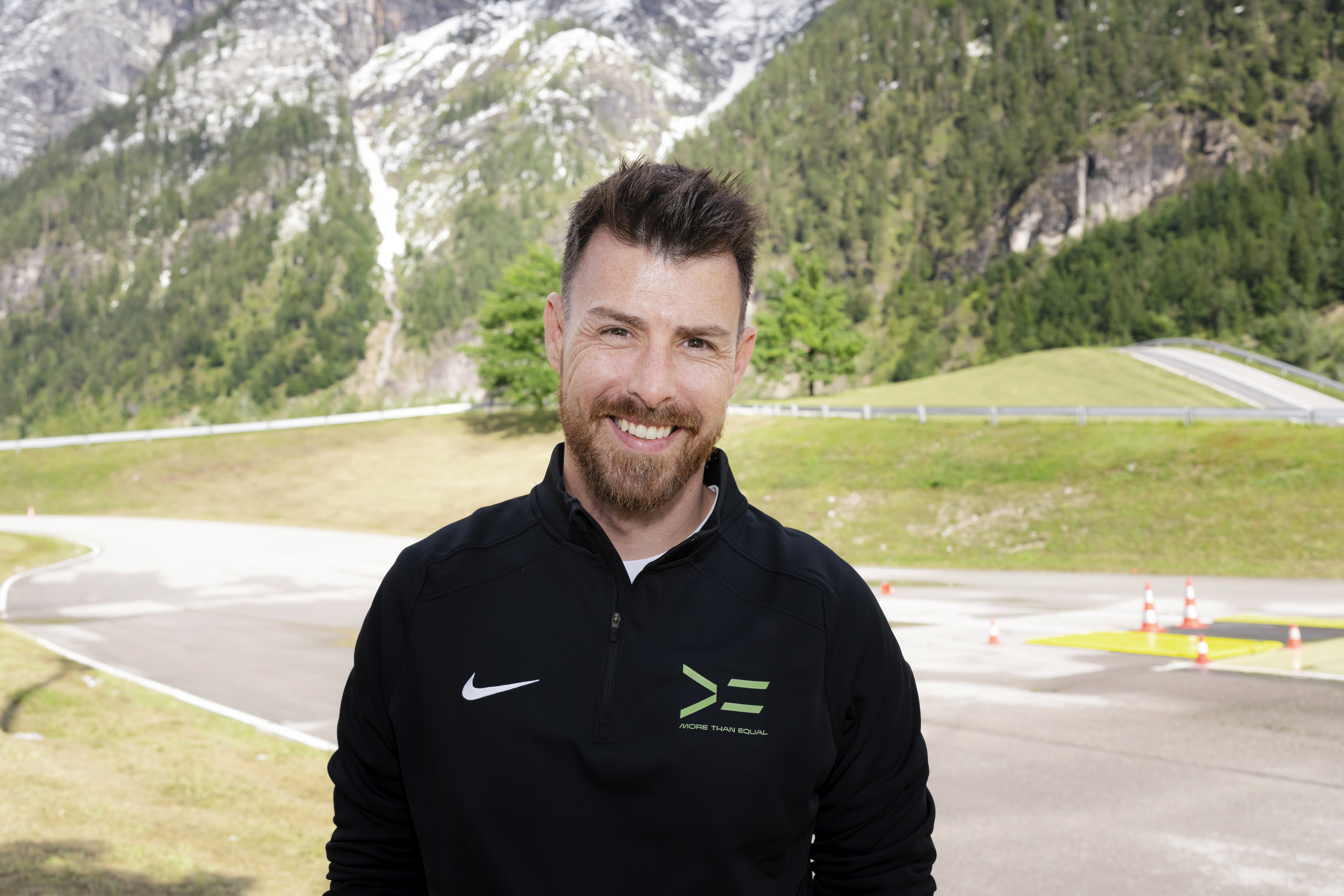
Running it is CEO Tom Stanton, who came to motorsport from the Olympic system. He ran the academy at British Cycling, one of the sport’s most decorated talent factories, and worked across GB Boxing before joining More Than Equal in 2021. He sat down with Hairpin Media to explain why the barrier keeping women off the grid isn’t the one most people assume and what it will actually take to break it.
Hairpin Media: Could you introduce yourself and share your journey into motorsport and your role at More Than Equal?
Tom Stanton: I'm a relative newbie to motorsport. I've been with More Than Equal formally since 2023, but actually back in 2021, I started doing consultancy with More Than Equal. I was brought in for my previous background, which was in performance sport in the UK within the Olympic system, where I was head of the Academy at British Cycling.
For the uninitiated, that's one of the best academies in the world, developing talent and putting it into medal-winning positions. I was very privileged to work there. [More Than Equal] came to me and asked, “Using that intelligence and insight you've got, could you help us answer some of the questions we have?”
Over the course of two years, we did a review of what the [motorsport] landscape looked like, both in terms of its operation and its impact; the people, the places, the performances; the barriers to performance, both situational and systemic, for female drivers; and also the perceptions surrounding those. What came from those [were three things]. One was called the Inside Track report. The second was an action plan for how to build a programme if we wanted to do that. The third was the factors we needed to bake into that [action plan], the key factors of performance or success for creating talent.
I then came on as head of driver development in 2023, and was responsible for creating the first programme. That was everything from identifying the talent, getting the talent to apply or be tested, filtering that down, and putting it into a programme that we then constructed. This was all done while we were sprinting and reading a map at the same time, because we were building things as we went.
It was pretty exciting, because [we] didn't really know what the next month was going to hold, because [we] hadn't defined it yet. That's how I arrived into it.
I was asked to come in as interim chief exec initially. Now I've been [CEO] for the last 18 months. Big shift, from running a performance programme right through to forming a performance organisation. It's been really interesting, exciting, stressful, worrying: all of those things wrapped into one.
HM: Since joining More Than Equal, what has surprised you most, and what has been the biggest learning curve?
TS: I think the hardest learning curve has been the specificities of the sport. In many of the sports I've operated in, there are always three factors, but they're balanced differently. The three factors [being] the talent the athlete or driver has, the connections required to move through whatever system they're trying to get to, and how they resource that [and move] through the system.
In motorsport, everything is dialled up to eleven. Everything has high fidelity, because you need very specific talent. You need very, very specific connections, and you need a tonne of opportunity, [which] is cash. There's no more sophisticated way of saying it.
Money generates talent because it allows you to have time on task. Money generates connections because it allows you to buy seats and buy favours, and all those kinds of things. I've never witnessed that in any other sport, and I've worked in some high-cost sports, but I think motorsport, and certainly how its ascendancy is going, [it’s] this ultra-high-net-worth sport. It’s just the way it's going.
That has blown my mind. For the first 18 months, I had to take zeros off the things we were paying for, just to try and understand it in some meaningful way. But I don't apologise for that when people challenge me on it from other sports, because it's just the reality of the sport. The sport is what the sport is, and the sport costs what the sport costs. It's no different to sailing or horse racing, in terms of its hard set-up costs and then hard ongoing costs. The irony, of course, is those two sports I just referenced are also the sports that are mixed gender.
HM: More Than Equal set out with a very specific goal: finding the first female Formula 1 World Champion. Why is now the right time to pursue that ambition?
TS: I suppose I would say, “Is there ever going to be a right time or a wrong time?” But I think the reason this has occurred is twofold. Firstly, through connections and happenchance, we had two founders who started talking and realised they had a shared passion for the sport. But also, why has [a female F1 world champion] not happened?
So, David Coulthard and Karel Komárek. David Coulthard, whose sister was a racer but who got the nod himself, and that's lived with him. That definitely fuels his motivation. Karel has a passion for sport and equality and making sure things can be different, but also for winning and performance. You don't get to do what [David has] done without having those kinds of drives as well.
Layered over that, is the fact that lockdown was a pain in many ways, but for Drive to Survive, it was a win. Once people had drained everything from Netflix and found Drive to Survive, the viewership, I'm sure it's an often-quoted statistic, was something like 42% female, which means that by [extension], the sport is now very close to that as well. I think it's [around] 38%.
So you've seen a complete narrative shift, from a middle-class older white guy wearing a Rolex, to a young 15-year-old wearing Nike Pros. I think there's been a shift there. In having that, what you then get is a scenario where those female viewers and fans, and male fans as well, [who are asking], “Well, hang on, why aren't there females there?” Many don't even realise that females could drive in F1, and they'd be forgiven for that. It's been 50 years since Lella Lombardi, the last [female driver in F1].
In fact, the FIA['s] rules are written "he" and "him." They're not even written "they" and "them." So there's a systemic forgetfulness about the sport. It's nothing to do with talent or potential.
It's also no one's fault, by the way, and I think everyone has to be really clear on that. No one set out to make it a male-only sport. It's the same way that gymnastics is a high-female sport. It's just one of those realities.
HM: From your perspective, how do you evaluate emerging markets like Asia when it comes to driver development and talent identification?
TS: In a global sport, that's always going to be the perennial problem: “how do you become truly global?” If [you] take football, it can be truly global because once you've established talent, and you've got a set of boots, a jersey, and a team, [then] talent naturally rises to the top. You've got a high volume of play, [and] the access to the sport is relatively low-level. To that end, and I can't believe I'd ever say this, it's probably one of the most uniform sports you could look at. It's crazy, really. It's a global sport for that reason.
The challenge we face, therefore, [comes down to] two or three things. One is understanding the difference in participation and performance between, [say,] Austria and Australia and Asia. How do you know the racing is at the same level? We'd all know it's not; there are varying levels.
Then, how do you track those performances in a situation where there's nothing that allows you to track it? When I first came in, my first [set of] question[s were], “Where's the data? Where are the results? Where are the drivers? Where are the performances? How do we track them?”
We couldn't, and we had a go at doing it. We did okay, but not great. That was our first go at it, our first learning journey. But we used that output to select our first cohort. We then said, “This didn't quite work. What wasn't working about it? How could we change it?”
[So] we built another system, called FutureLap, a global results database. Initially, it was set up [for] karting. The idea was, can we rank someone from Indianapolis or India? Can we rank someone from England or Egypt? And [also,] could we normalise the data? So if you account for the relative level of performance, you then look at their progression rate. That's what we've created.
I'm very, very proud of what we've done there, because it's unique in the system. No one else is doing this, and we've spent a lot of time, effort, and money on it. But what that allows us to do then is, as long as we've got the data from that race series, we can stack it up against everybody else. In our situation, that's really important, because our self-imposed decision to only work with female athletes completely changes what [we’re] trying to do.
If you're working with all athletes, you're simply selecting the best, and you choose your metric, whether it's performance, consistency, or potential, and you take from the big pile. The pyramid works like that.
With us, we're taking from a subsection of that, roughly speaking, 10%, maybe even 7%. It's not a huge population. So all of a sudden, you've got to give great consideration to the fact that we're only working with, let's say, 10% of the population. Then, the performance level will be variable. There'll be far fewer performing at those high levels, because there are far fewer people [overall]. And of that percentage, how many have the same opportunities as the male side?
What I mean by that is, for whatever reason, there are more sons and grandsons of billionaires in the sport than there are daughters or granddaughters of billionaires in the sport. I don't have the data to back this up; this is my presumption, [but] I think it's proportionally lower as well.
So all of a sudden, it becomes a smaller access [and] resource population. That becomes a real challenge. But that's also the reason we created this system: we're looking for needles in haystack.

HM: As talent identification becomes increasingly data-driven, what role do you see AI playing alongside human judgement?
TS: There's that famous phrase: “lies, damn lies, and statistics.” We know that having data is really useful. You also know you can tell whatever story you like with the data you've got.
Like other sports I've worked in, and I was an Olympic and Paralympic coach for a long time, data is only useful if you've got someone who understands it well enough to interpret it, and data alone can't help you make a decision. That's because we're dealing with humans, blood and guts. There's a blend of science, which is data, and art, which is human coaching, performance analysis, [and] knowing someone's got the X factor, because the X factor quite often is something you can't grade. It's not something you can measure, certainly not at the primary level. On a secondary or tertiary level, you can start to unpick what those X factors are, which is frustrating in many sports, because people go, “well, they've just got it. They're just quick." Well, okay, but what makes them quick? “They've just got raw speed.” But what makes them have raw speed? Tell me that, and then we can work it out.
I think these are incredible tools, for now and for the future. We've obviously leveraged AI with FutureLap. We've also used big data with FutureLap. You can start to use very powerful models to statistically predict. But prediction, like the weather and the stock markets, is just that. It's never 100% right. So I think always remembering that there's always a chance that it might be different. That's the human part.
HM: More Than Equal is often seen as a driver development programme, but it also conducts extensive research. What's the biggest misconception people have about the organisation?
TS: I guess the biggest misconception is that we're just a driver development academy. They'd be forgiven for that, because that's what we publicise. We don't talk about the iceberg that sits underneath.
We talk about drivers on a programme, doing test days, being supported by performance coaches. What we don't talk about is the PhDs that go into informing that data, the specialists we've brought in [who] can interpret that data and make it relevant to age, stage, gender, [and] performance level. We don't talk about the systems we're creating to try and understand the routes we should go through that aren't primary, designed routes. That's also important.
HM: Looking back on your career, both in and beyond motorsport, what has been your most memorable moment?
TS: It's so difficult, because I've been incredibly privileged to work across so many sports. So, if you'll permit me, I'll give you two.
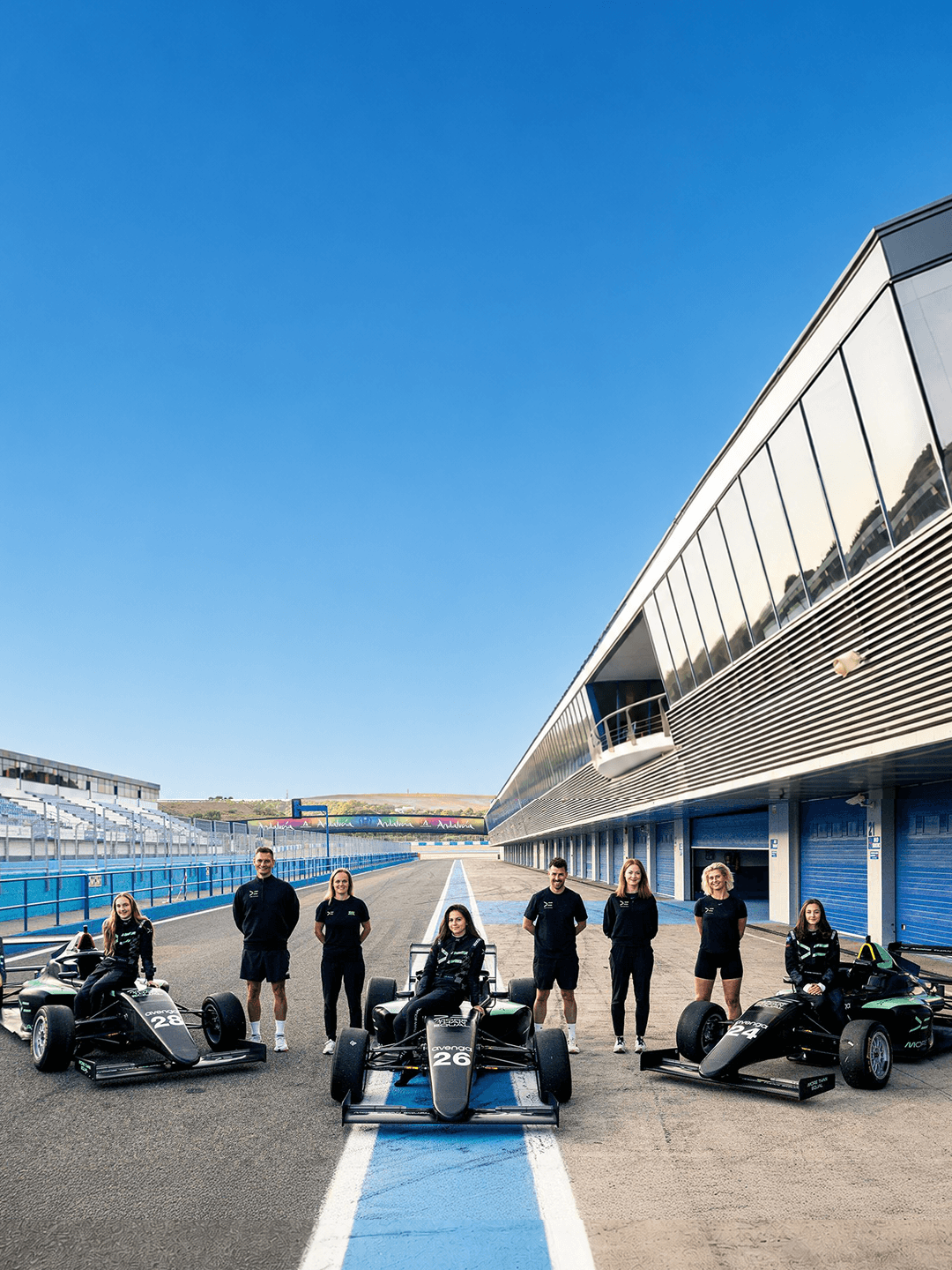
The first is related to where I am now. [With] our first cohort of drivers, we worked with them for 18 months, with the target of getting to their first F4 test. We set ourselves a pretty bold target of doing it in less than a year. That's going from having never driven a car – any car, not even their mum and dad's car – through to getting into an F4 car on a track.
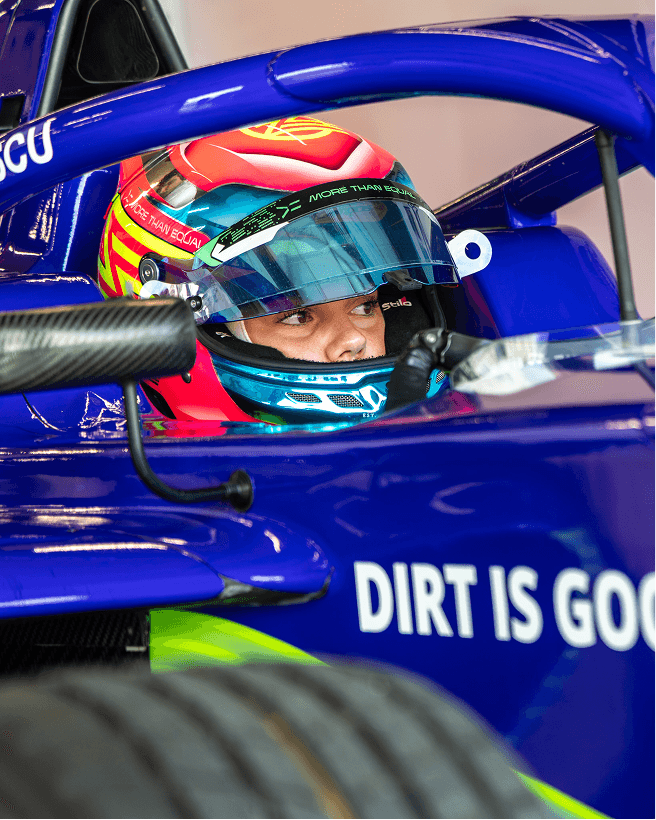
The day that arrived, we had three cars liveried up with three drivers who were liveried up – got their helmets on, look[ing] simultaneously badass and very, very small – getting in those cars and pulling out of the garage for the first time without stalling, joining the track, not spinning, and then being fast. That was a moment of, “wow, we are doing something that is truly special.” It still gives me goosebumps to think of that.
The second is far more social, and probably speaks to where I see sport [going]. When I worked at GB Boxing, it was a real culture shock. You go from high-cost sports like cycling and sailing down to boxing, which couldn't be more different. I went for a meeting in London, and walking across the road, I nearly got my head taken off by a scaffolding pole someone was just walking along with. I spun round to see who it was, and it was one of the boxers.
I was like, “What are you doing here? Why are you carrying scaffolding? I saw you in the gym yesterday, training.” He said, “I've got three kids, so I need to do extra work to bring the money in.” He was only young, this guy was only 20 years old. It made me realise the power of sport, particularly Olympic sport, in changing people's stars. [It is] the difference between him winning a medal and not is the difference between being a scaffolder or being a pro boxer, or something else. It was a moment that reminded me that what we do isn't just about the performances, but the people behind them.
That's been a significant motivation ever since that happened. We're not just making brilliant performers, brilliant bike riders, great drivers. We're also making brilliant people.
So those two live with me. I've been indulgent to have two, but for very big reasons, I think they're important.
As More Than Equal continues to combine scientific research, athlete development and data-driven decision-making, Stanton believes the future of motorsport depends on creating stronger pathways rather than searching for one exceptional individual. For him, the goal extends beyond producing a female Formula 1 World Champion, and into building an evidence-based system that gives talented drivers the opportunity to reach the highest level, regardless of the barriers that have traditionally stood in their way.
All images belong to More Than Equal